

Brussels Is Solving the Wrong Problem
European businesses are quietly telling their politicians something important. The politicians are not listening.

The European Commission is preparing a tech sovereignty package.
The stated goal is to reduce Europe’s dependence on American technology.
Its cloud infrastructure, its office software, its AI services.
The ambition is understandable.
The diagnosis, however, is wrong.
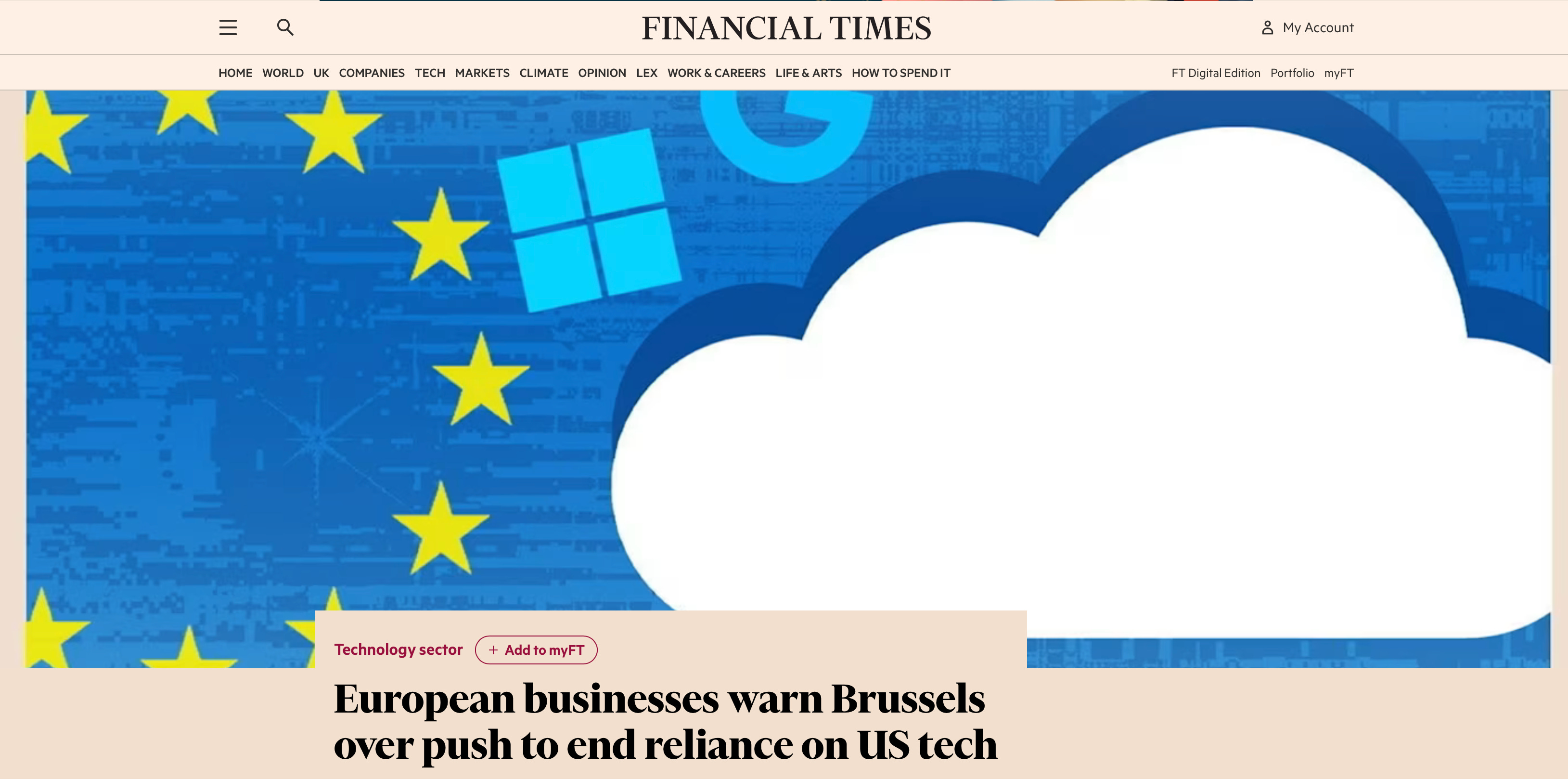
We know this because European businesses are saying so directly.
Commerzbank told the FT that the range and technological maturity of US platforms simply cannot be matched by European alternatives right now. A major European carmaker said switching away from existing infrastructure would cost too much and take too long. Thyssenkrupp’s chief executive said bluntly that Europe is not in a position to substitute its IT solutions with European ones.
These are not small companies hiding behind American coattails. These are the industrial backbone of the continent. And they are telling Brussels, as clearly as corporate diplomacy allows, that the tech sovereignty drive risks making European businesses less competitive at precisely the moment they can least afford it.
The question worth asking is not whether Europe should have a tech strategy.
It clearly should.
The question is whether trying to rebuild the cloud is the right one.
The Truth Nobody In Politics Wants to Say
There is a version of this debate that is entirely rational. Trump’s foreign policy has introduced genuine uncertainty into transatlantic technology relationships.
The kill switch fear is driving European leaders paranoid.It has become a recurring topic in boardrooms across the continent.
Kill switch is a scenario in which US cloud and software providers are forced to withdraw services from European customers through sanctions or executive action.
But the response to that risk matters as much as acknowledging it. And the response currently taking shape in Brussels is likely to produce neither sovereignty nor competitiveness. Build European clouds, develop European foundation models, replicate at vast expense what Silicon Valley built over three decades is a pipe dream worth burying beneath the NordStorm pipelines.
A German government insider quoted in the FT put it well, describing it as a trade-off between sovereignty and competitiveness. European companies, they said, need to focus on applying the best available AI models over the next three to four years or risk being overwhelmed by both Chinese and American competition.
That framing is more honest than most of what emerges from Brussels. You cannot out-hyperscale Google, Microsoft, or Amazon. You cannot out-model OpenAI and Anthropic by regulatory fiat.
What you can do and what Europe is actually positioned to do is something entirely different.
Own the Application Layer, Not the Foundation
There is a distinction in technology that rarely makes it into political speeches. The foundation layer is where the Americans and Chinese are engaged in a capital war that will cost trillions of dollars over the next decade. The models, the cloud infrastructure, the compute are a race defined by scale, by the ability to concentrate resources, by the kind of winner-takes-most dynamics that favour the largest players.
The application layer is different. This is where AI gets applied to specific industries, specific workflows, specific problems.
Healthcare diagnostics. Industrial automation. Precision agriculture. Advanced manufacturing. Defence systems. Energy grid management.
These are domains where deep domain knowledge, regulatory relationships, and physical infrastructure matter as much as algorithmic horsepower.
Europe has genuine competitive advantages in almost every one of those domains.
ASML makes the machines that manufacture the chips that run the AI. Siemens and Schneider Electric run the industrial infrastructure of the modern world. Airbus builds the aircraft. Rheinmetall and BAE Systems are rapidly becoming the architects of the AI-enabled battlefield. Novo Nordisk is demonstrating what happens when you apply world-class science to a specific biological problem at global scale.
None of these companies needs to build a cloud. They need to apply the best available AI to the domains they already own. And crucially, they are already doing exactly that. Largely using American platforms, because those platforms are currently the best tools available.
Atoms, Not Algorithms
Here is the investment framework I keep returning to:
The AI era is deflating the value of software and inflating the value of physical things. Intelligence, at the model layer, is becoming abundant. What remains scarce is the physical world that AI needs to actually do anything useful beyond generating text.
The infrastructure, the materials, the manufacturing capacity, the energy systems.
Europe’s economy is overwhelmingly built on atoms. It manufactures things. It builds things. It moves things. It has deep expertise in the physical industries that AI is about to transform most dramatically. That is not a weakness to be apologised for. It is a structural advantage to be exploited.
The irony is rich.
For two decades, Europe was mocked for failing to build the next Google or Facebook. Its tech sector was small, fragmented, and over-regulated. Meanwhile America and China built the software platforms that came to dominate the global economy. In that software-first world Europe fell behind.
But the world is shifting.
The next decade is not about who builds the best model. It is about who applies intelligence most effectively to the physical economy.
Energy transition. Autonomous logistics. Smart manufacturing. AI-enabled defence. Precision medicine.
These are European domains. Europe did not miss the AI revolution. It is sitting directly in the path of the part of it that matters most.
What Brussels Should Actually Do
The smart European tech policy is a strategy built around three honest realities, not a sovereignty package that tries to replicate Silicon Valley.
First, use the best available tools. If American AI models are currently superior, European companies should use them and gain the productivity benefits. Handicapping your own businesses in a global competition to score a political point is self-harm, not sovereignty.
Second, build leverage rather than walls. The answer to dependency risk is negotiating power, not isolation. Europe has real leverage over American tech companies: its market, its regulatory authority, its data. Use that leverage to secure contractual guarantees, data residency commitments, and continuity protections. That is far more practical than trying to build a European version of AWS from scratch.
Third, invest aggressively in the physical layer. Europe’s real technology strategy should be pumping capital and policy support into the industries where it already has structural advantages. Defence technology, energy infrastructure, advanced manufacturing, critical minerals processing, and industrial AI applications. These are the sectors where European companies can build genuine global leadership over the next decade.
The businesses speaking to the FT are not arguing against European ambition. They are arguing for European pragmatism. There is a difference between a strategy and a slogan. Tech sovereignty, as currently conceived, risks being the latter.
Europe’s advantage was never algorithms. It was always the world those algorithms need to operate in.