

Coinbase Hack - Why Coinbase’s Balance Sheet Is Resilient—But Its Reputation Must Not Be Overlooked
Assessing the Aftermath of the Coinbase Hack—Financial Fortitude Meets Reputational Risk in the Crypto Industry

On your commute, tune in to the Notebook LM-generated podcast discussion inspired by my article.
TL;DR
What happened? - Cyber criminals reportedly gained access to less than 1% of Coinbase's customer data.
What specific types of customer data were stolen during the incident? - They got access to Name, address, phone, and email; Masked Social Security (last 4 digits only); Masked bank‑account numbers and some bank account identifiers; Government‑ID images (e.g., driver’s license, passport); Account data (balance snapshots and transaction history); Limited corporate data (including documents, training material, and communications available to support agents)
What types of customer assets or information were not compromised in the hack? - Login credentials or 2FA codes, Private keys, Any ability to move or access customer funds, Access to Coinbase Prime accounts, Access to any Coinbase or Coinbase customer hot or cold wallets.
How did they get it? - Cyber criminals bribed and recruited rogue overseas support agents to steal Coinbase customer data by abusing their access to customer support systems.
Why did the online criminals target Coinbase? - To extort $20 million in ransom
What action is Coinbase taking regarding the criminals responsible for the attack? - Coinbase has backed down from paying the ransom and instead is establishing a £20 million reward fund for information leading to the arrest and conviction of the criminals responsible for the attack. This is a great demonstration of character.
How is Coinbase responding to the customers whose data was accessed and who were tricked into sending funds to the attackers? - Coinbase is reimbursing customers who were tricked into sending funds to the attacker and has already notified affected customers via email.
What is one key piece of advise Coinbase gives customers to avoid being scammed? - Only permit transfers to wallets that you are confident you fully control and where the seed phrase is secure and was not provided to you or shared with anyone.
What is the estimated cost of the hack? - In its SEC filing, Coinbase states the estimated cost of the hack is between $180 - $400 million.
What is the impact of this cost on Coinbase? - Coinbase is well capitalised to fund this cost. They have a cash horde of $10 billion and this will be a 0.4% hit to their balance sheet. They also have the ability to fund this from their Operating Cash Flow for the remainder of this year.
However, it is the reputational damage that now requires careful management. Coinbase, long regarded for its advocacy of regulatory compliance and robust hiring standards, has seen its formidable standing challenged by this incident. Nevertheless, this setback is far from irreparable, and there is no need for investors to hastily liquidate their positions in the company.
Introduction
The recent hack at Coinbase has reignited debate about the security and resilience of centralised cryptocurrency exchanges. While the breach has drawn criticism from customers and industry observers alike, the central message of this essay is clear: Coinbase’s robust capital position ensures it is well placed to absorb the financial impact of the incident. This essay will examine the details of the hack, market and community reactions, the company’s financial strength, both the bull and bear cases for its future, and expectations for how Coinbase should improve its security posture.
Details of the Hack
According to Coinbase’s official disclosure, the breach was orchestrated by a small group of overseas support agents who were bribed to leak customer data. The incident affected less than 1% of monthly transacting users and resulted in the exposure of names, addresses, phone numbers, emails, masked Social Security numbers, and some masked bank account details. Crucially, no passwords, private keys, or customer funds were accessed, and all Coinbase Prime accounts and wallets remained uncompromised. Following a failed US$20 million extortion attempt, Coinbase refused to pay and instead offered a US$20 million reward for information leading to arrests. The company has pledged to reimburse customers who were tricked into sending funds to attackers and has already taken steps to strengthen internal controls and support operations.
Market and Community Reaction

The hack has provoked a strong and emotional response on social media, particularly on X. Influential voices have highlighted the human cost of data exposure, arguing that the consequences extend far beyond direct financial losses. Criticism has focused on perceived operational lapses, such as the use of unencrypted data and offshore contractors, and on the regulatory environment that compels exchanges to collect and store sensitive personal information. There is a clear sense of frustration with Know Your Customer (KYC) requirements and a growing distrust of centralised platforms. Customers have shared stories of poor support and heightened vulnerability to phishing and scams, underscoring the reputational damage inflicted by the breach.
Financial Overview and Capital Position
Despite the operational setback, Coinbase’s financial position remains exceptionally strong. As of Q1 2025, the company’s cash position per its balance sheet stands at US$10.33 billion.
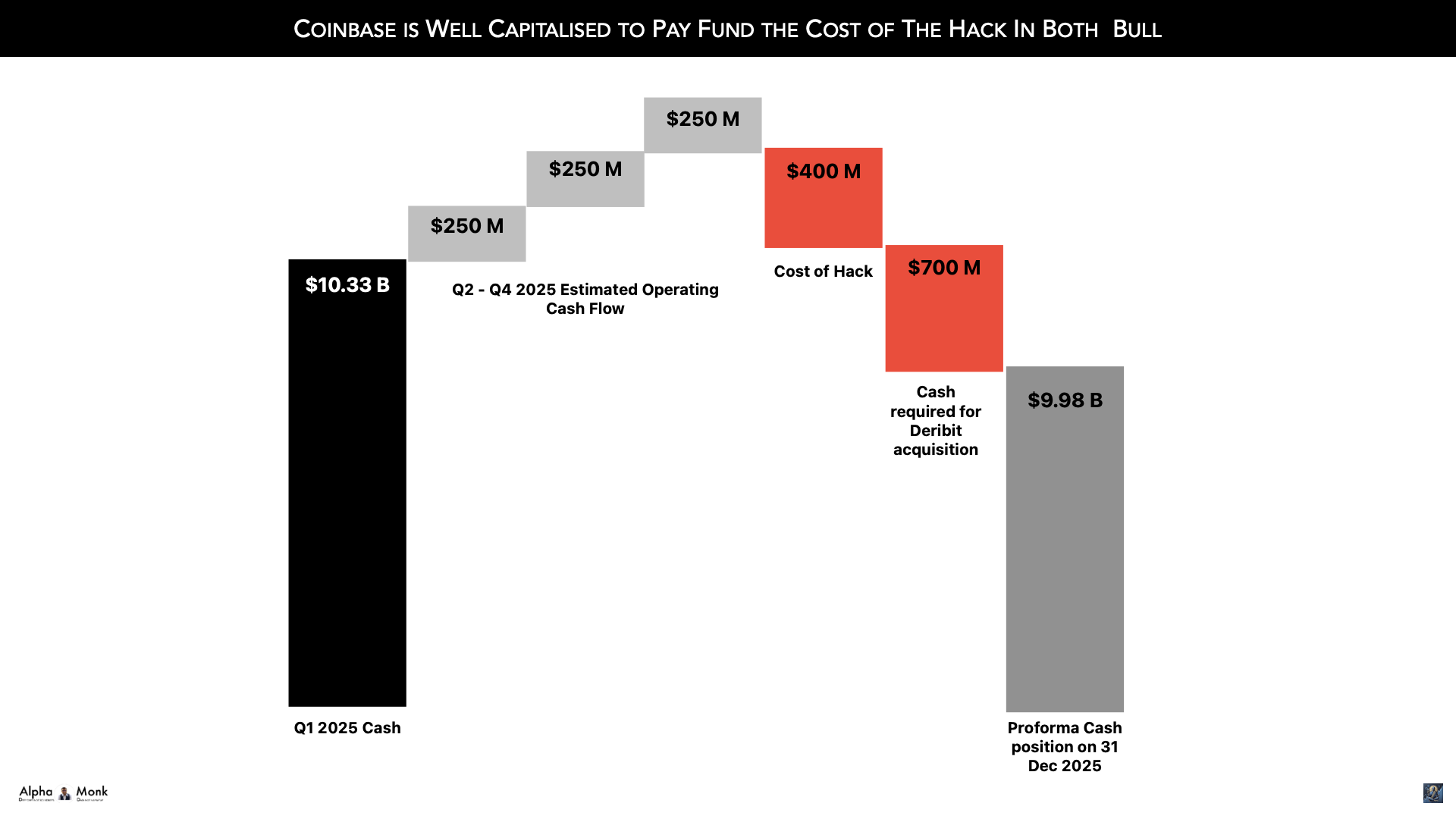
In a bull scenario, if the company generated an average of $250 million in positive operating cash flow, even after accounting for an estimated US$400 million in hack-related costs and US$700 million for the Deribit acquisition, the company could close 2025 with $9.98 billion in cash.
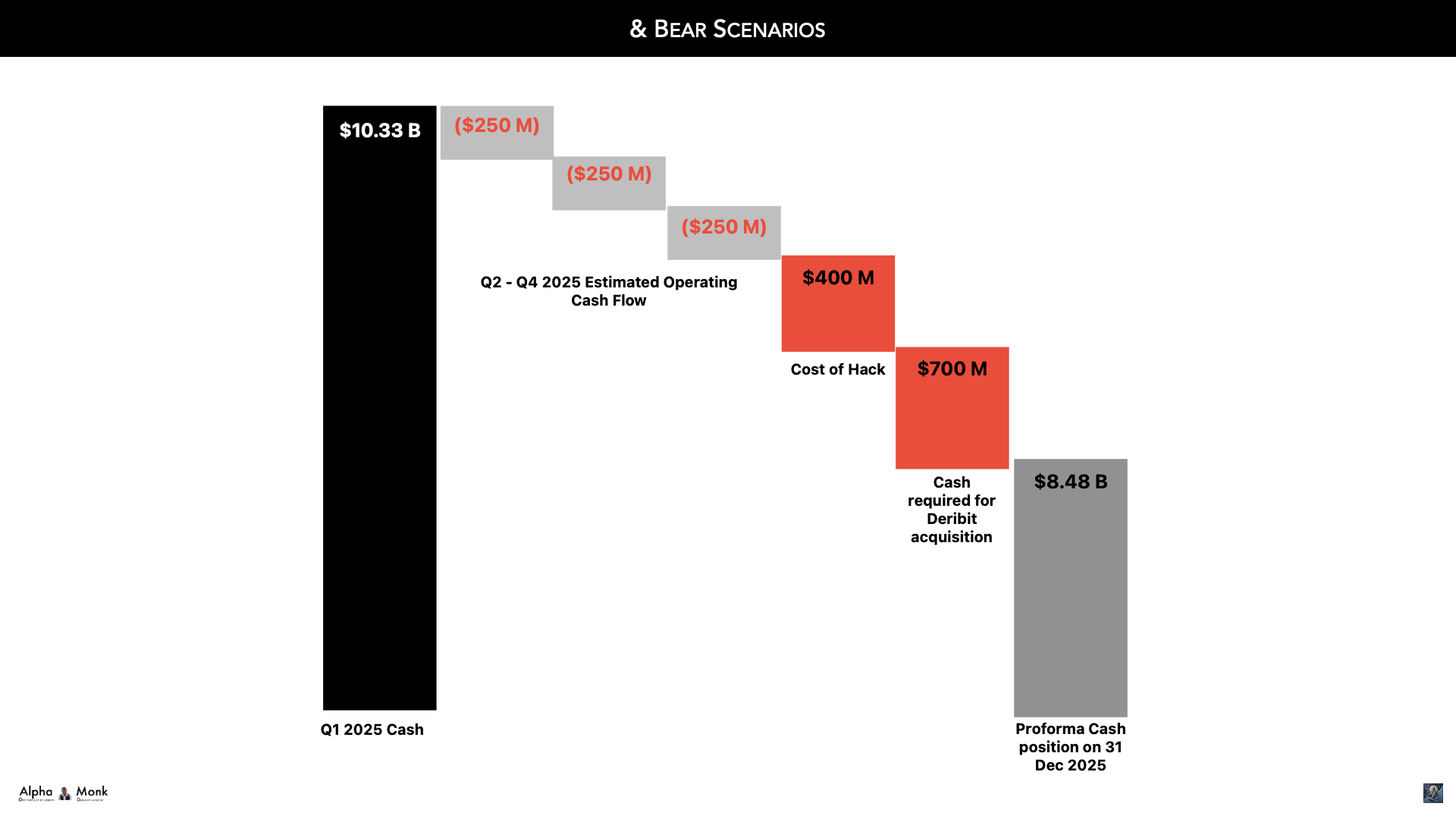
In a bear scenario, if the company ended up with a negative cash flow of $250 million for the next 3 quarters, its cash position will still be a robust $8.48 billion after accounting for $400 million in hack costs and $700 million to fund the Deribit acquisition.
Historical data supports this resilience, with Coinbase consistently maintaining multi-billion-dollar cash reserves and demonstrating prudent risk management throughout periods of crypto market volatility. The company’s ample cash reserves, strong cash flow generation, and disciplined expense management ensure that the costs of the hack are well within its capacity to absorb. There is no evidence of material deterioration in core business metrics such as trading volumes or monthly transacting users. The company’s diversified revenue streams, including growing contributions from subscriptions and services, provide additional stability. Management’s scenario planning and rapid cost control measures further support the view that Coinbase can navigate both extraordinary events and prolonged market downturns without threatening its long-term growth trajectory.
Risks and Vulnerabilities
Nevertheless, the hack exposes several risks that could erode Coinbase’s capital buffer under adverse conditions. Reputational damage and loss of customer trust could lead to sustained declines in platform activity and revenue. Regulatory scrutiny may intensify, potentially resulting in fines, forced changes to product offerings, or increased compliance costs. Operationally, the incident highlights vulnerabilities in internal controls and the risk of insider collusion. The capital position bridge, while robust under base-case assumptions, is sensitive to prolonged market stress, underperformance in operating cash flow, or escalation in hack-related liabilities. In a severe bear scenario, these factors could significantly reduce Coinbase’s liquidity and strategic flexibility.
Official Disclosure and Its Implications
Coinbase’s official communication has been transparent and proactive. By clarifying that no customer funds or private keys were accessed and by committing to customer reimbursement, the company has contained the immediate financial and operational fallout. The refusal to pay the ransom and the swift implementation of enhanced controls demonstrate a strong crisis management response. While the risk of regulatory investigation remains, the limited scope of direct financial damage and the company’s cooperation with law enforcement should help to mitigate longer-term reputational harm.
Expectations for Security Improvements
In light of the breach, I expect Coinbase to take further steps to strengthen its security posture. This should include continued investment in insider-threat detection, hardening of internal controls, and the relocation of sensitive support functions to more secure, onshore facilities. Coinbase should also enhance transparency around its security practices and incident response protocols, and consider adopting industry best practices such as end-to-end encryption of customer data, regular third-party security audits, and robust employee training on data protection. Proactive engagement with regulators and customers will be essential to rebuilding trust and demonstrating a commitment to safeguarding user assets and information.
Conclusion
The Coinbase hack is a significant event, but it does not threaten the company’s financial stability or long-term prospects. Coinbase’s strong capital position, disciplined risk management, and decisive operational response provide a solid foundation for absorbing the costs of the breach and restoring confidence. While the incident highlights real risks — particularly around reputation, regulation, and internal controls — it also offers an opportunity for Coinbase to lead the industry in security and transparency. With continued vigilance and investment in its security infrastructure, Coinbase remains well positioned to maintain its leadership in the evolving crypto landscape.
Disclaimer:
I own shares in Coinbase, which may influence my perspective. The information provided in this essay reflects my research and understanding as of May 2025 and is intended for informational purposes only. It does not constitute investment advice or a recommendation to buy or sell any security. The content is subject to change at any time without notice, and the accuracy or completeness of the information cannot be guaranteed. Please conduct your own due diligence and consult a qualified financial adviser before making investment decisions.
Why settle for free samples when you can feast on the full buffet? Unlock premium insights, deep dives, and witty commentary for just $45 a month or $450 a year. Go on-your portfolio (and your curiosity) deserve the VIP treatment!