

Stop watching the missiles. Start watching the money.
What the Iran conflict is really about, who is winning, and where the money is going

A note on this essay: the framework below draws heavily on the analysis of macro commentator Simon Dixon. I credit him directly throughout. Where I challenge his arguments, I do so in the spirit of honest enquiry, not dismissal. Some of his claims are speculative and cannot be verified. Others are supported by market behaviour that is difficult to explain any other way. I leave you to judge.
Glossary of Terms
Before diving into the essay itself, I want to flag some of the economic and geopolitical language I have had to learn to make sense of this analysis. These are not terms I grew up with. If they are new to you too, this section is worth reading first.
K-shaped economy
An economy where the recovery or growth after a shock splits into two diverging paths. Those who own assets (property, stocks, businesses) see their wealth rise. Those who rely on wages see their living standards stagnate or fall. The letter K captures the shape: one arm pointing up, one pointing down. The pandemic accelerated this split dramatically, but the structural causes go back decades.
Petrodollar
The system established in the 1970s whereby global oil is priced and traded in US dollars. This arrangement was negotiated between America and Saudi Arabia after the US came off the gold standard in 1971. It means that any country wanting to buy oil must first acquire dollars, creating a permanent global demand for American currency and, by extension, American Treasury bonds. It is the foundation of dollar supremacy in the post-Bretton Woods era.
Financial-Industrial Complex (FIC)
Simon Dixon’s term for the network of global investment banks, asset managers, private equity houses, sovereign wealth funds, and the policy institutions they influence. Distinct from the Military-Industrial Complex in that its primary profit motive is not war itself but the financing of war, the management of capital flows, and the reconstruction and privatisation that follows conflict. Dixon argues the FIC now sits above the MIC in the hierarchy of global power.
Military-Industrial Complex (MIC)
A term coined by US President Dwight Eisenhower in 1961 to describe the relationship between the defence industry, the military, and the political establishment. The MIC profits from weapons production, military contracts, and geopolitical conflict. Its economic model requires ongoing threat, ongoing spending, and ongoing war. Dixon uses it to describe the faction currently being displaced by the FIC in the global power hierarchy.
Technical-Industrial Complex (TIC)
This is Dixon’s term for the network of big technology companies, surveillance infrastructure builders, data brokers, and algorithmic media platforms that have grown into a third pillar of global power alongside the MIC and FIC. Think of the companies building AI systems, facial recognition, predictive policing tools, social media algorithms, and central bank digital currency infrastructure. The TIC profits not from war or capital flows directly, but from data, attention, and control. Its product is the architecture of a managed population. Dixon sees it as increasingly intertwined with both the FIC and the state, providing the surveillance and behavioural control layer that sits on top of the financial and military layers beneath it.
Proof of Weapons Network
Dixon’s framework for understanding how the FIC, the MIC, and the TIC operate together as an interlocking system. He uses the analogy of Bitcoin’s proof of work as the resistance mechanism against this network, arguing that financial self-sovereignty is the individual’s defence against a system built on debt, surveillance, and coercion.
Financialisation of the economy
The process by which financial instruments, financial institutions, and financial motives come to dominate economic activity that was previously driven by production, manufacturing, or trade. In a financialised economy, the most profitable activity is not making things but managing, trading, and leveraging claims on things. America’s economy is now roughly 70 per cent services, with a large portion of that being financial services. This hollowing out of the productive base is a central theme in understanding why the US is in long-term relative decline.
Multipolar world
A global order in which power is distributed among multiple major actors rather than concentrated in one (unipolar, as under US dominance post-1991) or two (bipolar, as during the Cold War). The emerging multipolar world features the US, China, Russia, India, and the Gulf states as distinct power centres with their own spheres of influence, currencies, and trade arrangements. Much of the current geopolitical turbulence, from tariffs to the Iran conflict, can be understood as the managed or contested transition from unipolarity to multipolarity.
Fiscal dominance
A condition in which a government’s debt levels become so large that monetary policy is effectively subordinated to fiscal needs. Rather than the central bank independently setting interest rates to control inflation, it is forced to keep rates low (or to print money) in order to make the government’s debt serviceable. The US is argued by many macro analysts to be approaching, or already in, a state of fiscal dominance. It implies that inflation is a policy choice, not an accident.
Force majeure
A legal clause in a contract that allows one or both parties to suspend their obligations in the event of extraordinary circumstances beyond their control, such as wars, natural disasters, or pandemics. In the context of the Iran conflict, private credit funds invoked force majeure to suspend redemptions for retail investors, effectively locking their money in place. The term literally means superior force in French.
Strategic petroleum reserve (SPR)
Government-held emergency stockpiles of crude oil, maintained by major consuming nations to buffer against supply disruptions. The US SPR, stored in underground salt caverns in Louisiana and Texas, is the largest in the world. Releasing SPR supplies into the market is one of the few tools governments have to quickly suppress an oil price spike. The Biden administration drew the SPR down significantly during the Russia-Ukraine energy crisis, leaving it at historically low levels heading into the Iran conflict.
De-dollarisation
The gradual process by which countries reduce their dependence on the US dollar for trade, reserves, and debt. This includes settling bilateral trade in local currencies, accumulating gold instead of Treasury bonds, and building alternative payment systems to SWIFT. Russia and China have accelerated their de-dollarisation since Western sanctions froze Russian reserves in 2022, demonstrating to the rest of the world that dollar-denominated assets could be weaponised.
Private credit markets
The ecosystem of non-bank lending, where institutional investors (pension funds, endowments, insurance companies, and wealthy individuals) lend directly to businesses or projects through private funds, bypassing traditional banks. Private credit grew enormously after the 2008 financial crisis as banks retrenched from business lending. It now funds significant portions of the AI infrastructure buildout, leveraged buyouts, and real estate development. Unlike public bond markets, private credit is illiquid and opaque, making it a source of hidden systemic risk.
Proof of work / self-custody
Bitcoin concepts with broader philosophical implications in Dixon’s framework. Proof of work refers to the computational process by which Bitcoin transactions are validated, requiring real energy expenditure and making the system resistant to manipulation. Self-custody means holding your own Bitcoin private keys rather than trusting an exchange or institution to hold them for you. Dixon uses both as metaphors for financial sovereignty: the idea that individuals can opt out of a system designed to keep them in perpetual debt and dependency.
Genocide-as-a-service
A deliberately provocative term used in some alternative media analysis to describe the outsourcing of military violence by major powers to client states or proxy forces, with the sponsoring power maintaining plausible deniability. In the context of Gaza, critics use it to describe the role of US military and diplomatic support in enabling Israeli operations, arguing that the destruction served specific strategic objectives for multiple parties beyond the stated aims. I include it here not as an endorsement but because it appears in the analysis I am drawing on and readers deserve to know what it means.
How We Got Here: A Brief History of the System
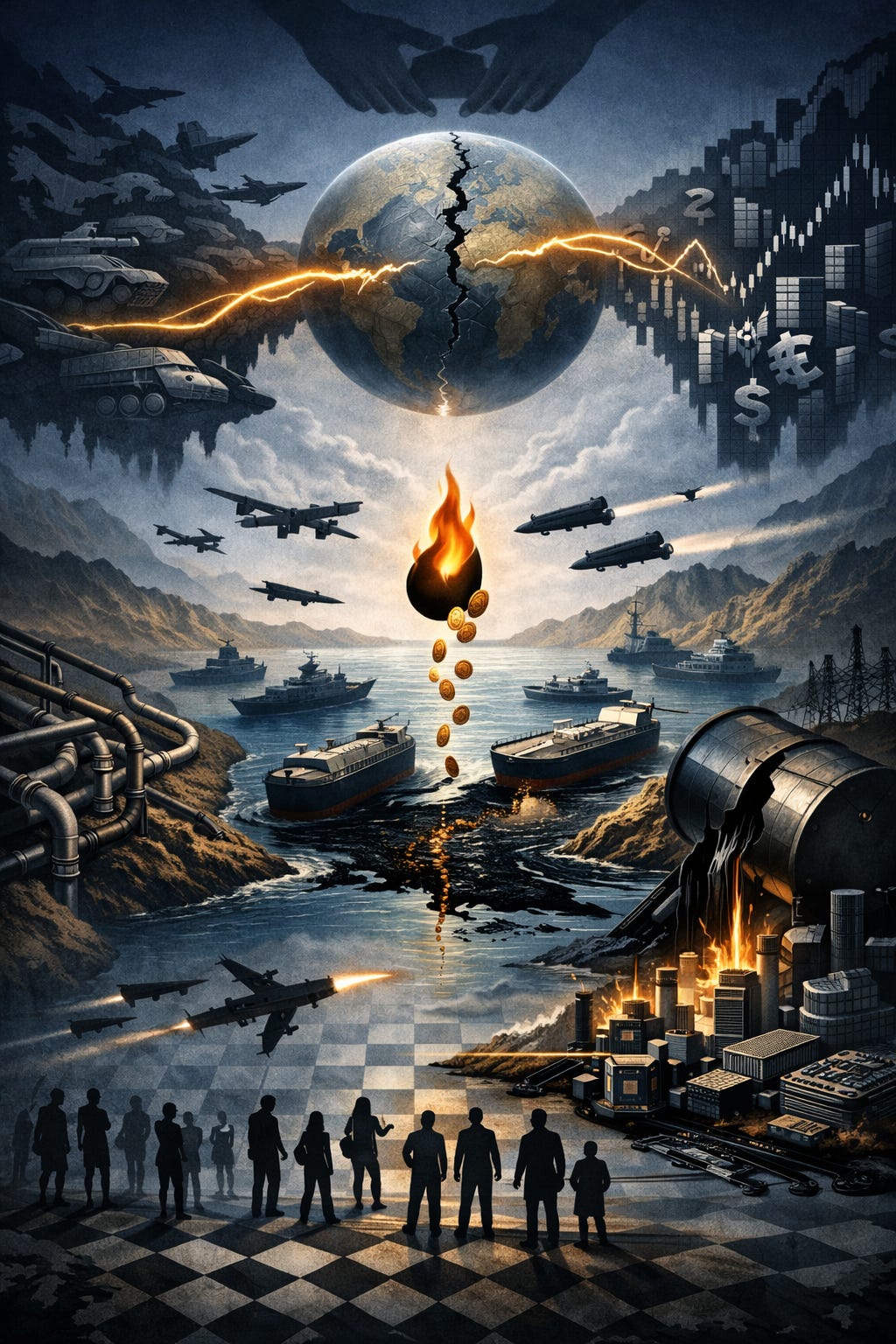
Dixon’s analysis does not exist in a vacuum. It draws on a specific reading of economic and imperial history that is worth sketching briefly. Understanding this arc makes the current moment considerably less confusing.
1600s to 1700s: The East India Companies
The British East India Company and the Dutch East India Company were the first truly global corporations. They were privately owned, state-backed, and militarised. They did not just trade; they colonised, taxed, and governed entire territories. Their model, extracting resources from the periphery and concentrating wealth at the centre, became the template for all subsequent imperial expansion. Crucially, they privatised the profits of empire while socialising the costs through state military power. Dixon sees direct continuity between this model and the modern FIC.
1800s: The British Empire and the Bank of England
Britain’s industrial revolution and naval supremacy made sterling the world’s reserve currency. The Bank of England, nominally private, sat at the centre of a global financial web that channelled the wealth of empire into London. When the costs of empire became unsustainable, the same financial institutions that had profited from expansion found ways to profit from contraction, financing the wars that ended British hegemony and positioning themselves to survive the transition to American dominance.
1913 to 1945: The Federal Reserve, Two World Wars, and the Transfer of Power
The creation of the US Federal Reserve in 1913 established a privately owned central bank at the heart of American monetary policy. The same network of European banking families that had financed the British Empire helped establish it. Both World Wars accelerated the transfer of global financial power from London to New York, with America emerging in 1945 as the world’s dominant military and economic power, holding the majority of the world’s gold reserves.
1944 to 1971: Bretton Woods and the Dollar Standard
The Bretton Woods agreement made the US dollar the anchor of the global monetary system, with all other currencies pegged to the dollar and the dollar convertible to gold at $35 per ounce. This gave America extraordinary privilege: it could print the world’s reserve currency. When the costs of the Vietnam War and the Great Society programmes made the gold peg unsustainable, Nixon closed the gold window in 1971. This was, in effect, a default. It also freed America from any external constraint on money creation.
1973 to 1980s: The Petrodollar and Financialisation
With gold backing gone, the dollar needed a new anchor. The petrodollar system, negotiated with Saudi Arabia in 1973 to 1974, provided it. Oil priced in dollars meant permanent global demand for American currency. Simultaneously, the deregulation of financial markets in the late 1970s and 1980s unleashed the financialisation of Western economies. Manufacturing moved offshore. Capital markets grew. Debt became the primary driver of growth.
1990s to 2008: Globalisation, China, and the Hollowing Out
China’s entry into the World Trade Organisation in 2001 accelerated the offshoring of Western manufacturing at scale. China absorbed the industrial base, building the world’s largest manufacturing economy. Western financial institutions profited from the intermediation of this process. By 2008, the US economy was so financialised that the failure of a single class of mortgage-backed securities nearly brought down the entire global system. The bailout that followed transferred enormous wealth from taxpayers to financial institutions.
2008 to present: The End of the Unipolar Moment
Since 2008, the trajectory has been clear even if the pace has been debated. China’s GDP has grown from roughly 30 per cent of America’s to approaching parity. Russia, after the 2022 sanctions shock, has deepened its pivot towards Asia. The Gulf sovereign wealth funds have shifted from buying US government debt to buying US and global equities, changing their relationship with American power from creditor to co-owner. BRICS has expanded. The dollar’s share of global reserves has declined. The Iran conflict, on this reading, is not an aberration. It is the latest episode in a long and largely predictable story.
The War Behind the War
There is a version of the Iran conflict that most people are watching. Missiles. Drone strikes. Oil markets in freefall. Trump posting on Truth Social at 2am. It is dramatic, confusing, and designed to be both.
Then there is another version. Quieter. More deliberate. Harder to see unless you stop watching the missiles and start watching the money.
That second version is what macro analyst Simon Dixon has been mapping in real time. His framework is not comfortable. It will frustrate people who have strong feelings about any of the parties involved. But as an investor trying to understand what is actually driving markets right now, it is the most coherent lens I have found. This essay breaks it down, challenges it honestly, and draws out what it means for how we position our money.
Stop watching the missiles. Start watching the money.
Watch the entire Simon Dixon podcast here.
I. Two Industrial Complexes, One War
Dixon’s starting point is this: the real war in the Middle East is not being fought between Iran, Israel, and America. It is being fought between two factions of global power that use nation states as proxies.
The first is the Military-Industrial Complex. Its economic model depends on permanent conflict. War is not a failure state for the MIC. War is the product. It wants a forever war. The second is the Financial-Industrial Complex. Its model is different. It profits from financing wars, yes, but its real prize is reconstruction, privatisation, and the renegotiation of energy and capital flows that follows. The FIC wants a managed transition to a stable, profitable new order. It does not want forever war. Forever war is bad for asset prices.
Dixon argues the FIC is currently winning. And the Iran conflict is less a war than a controlled demolition of the old order, with the rubble already being priced into contracts before the dust settles.
The case for
The market behaviour during week two of the conflict is difficult to explain under any other framework. If this were a genuine all-out war, you would expect gold surging towards $6,000/oz, oil well above $150, and equity markets in severe decline globally. None of that happened. Oil was capped at $115 and crashed back to $89. Gold barely moved. The S&P 500 pulled back modestly. That is not how markets behave when they believe they are looking at World War Three. It is how they behave when the sophisticated money already knows, broadly, how the story ends.
Furthermore, the decision by risk insurers to pull coverage for ships but not for planes travelling through the same airspace is extraordinary. It implies coordination, not random market reaction. Insurance markets do not make that distinction by accident.
The case against
The MIC versus FIC framework is elegant but risks being unfalsifiable. Almost any outcome can be retrofitted into it. If the war escalates, Dixon can say the MIC is fighting back. If it de-escalates, he can say the FIC won. A framework that can explain everything explains nothing. Furthermore, attributing coordinated intent to thousands of independent actors across insurance markets, sovereign governments, and private institutions requires a level of centralised control that strains credibility. Markets can produce outcomes that look coordinated simply through shared incentives, without any single hand on the tiller.
My verdict: The MIC versus FIC lens is the most useful organising framework I have found for this conflict, but I hold it loosely. It explains the market signals better than any alternative narrative I have encountered. What it cannot do is prove intent. I treat it as a map, not a photograph.
II. The Strait of Hormuz: A Financial Weapon, Not a Military One
Roughly 20 per cent of all global oil, as well as significant volumes of liquefied natural gas, passes through the Strait of Hormuz. When it closes, energy markets convulse. When it stays closed, the global economy begins to fracture.
But the Strait was not physically blocked by naval force. What closed it was insurance. War risk underwriters withdrew coverage, making it commercially impossible for any vessel to pass through. At the same moment, thousands of flights were cancelled across the region, but aviation insurance was not pulled. Planes kept flying. Ships stopped sailing.
Dixon reads this asymmetry as deliberate. The financial system, he argues, did what missiles could not. And the insurance market, controlled by institutions at the centre of the FIC, made a strategic choice.
The initial market reaction was violent. Oil futures hit $115 from a pre-war price in the mid-fifties. Asian equity markets triggered circuit breakers. South Korea was particularly hard hit given its dependence on both energy imports and the semiconductor supply chains that underpin the global technology economy. Then came the reversal. Within days, oil crashed back to around $89, driven by Trump announcements, G7 SPR release pledges, and most significantly, Russian oil shipments moving again after quiet sanctions relief from the US Treasury.
America went to war with Iran and within days quietly lifted sanctions on Russia to keep oil prices down.
The case for
The insurance asymmetry is genuinely hard to explain without invoking deliberate choice. The risk profile for planes flying over the region was not materially different from the risk profile for ships sailing through it. Yet one market pulled coverage and the other did not. If this were purely a risk-based commercial decision, you would expect symmetry. The fact that it was asymmetric suggests something else was operating.
The Russia sanctions relief is equally telling. If the conflict were a genuine ideological confrontation with the axis of authoritarian states, lifting Russian oil sanctions within days would be political suicide. It happened anyway. The price ceiling was the priority, not the narrative.
The case against
Aviation and marine insurance are entirely separate markets with different risk models, different underwriters, and different regulatory frameworks. Ships travel slowly through a defined chokepoint and cannot be rerouted. Planes can change altitude, routing, and timing in real time. The asymmetry may reflect genuine operational risk differences rather than coordination. Lloyd’s of London withdrawing marine cover is not evidence of a conspiracy. It may simply be evidence that the marine risk was quantifiably catastrophic while the aviation risk, though elevated, remained manageable.
Similarly, the Russia sanctions relief may reflect pragmatic crisis management rather than a pre-arranged script. Governments under acute pressure use whatever tools are available. Russia happened to be a useful lever. That does not require advance coordination.
My verdict: The insurance asymmetry is the single most compelling piece of evidence Dixon presents. I cannot fully dismiss it. But I am cautious about reading deliberate orchestration into what may be the emergent outcome of many actors responding to shared incentives under pressure. The Russia sanctions relief, however, does require explanation. That decision was made at speed, at the highest level of the US Treasury. It is difficult to reconcile with the stated rationale for the conflict.
III. Russia is Quietly Winning
Of all the actors in this conflict, Russia’s position is the most straightforwardly advantageous. Before the war, Russian oil was selling at a heavy discount due to sanctions, roughly $35 to $40 per barrel. Now it is approaching $100. That is a near-tripling of revenue, with no additional costs and no military involvement required.
That windfall is not being recycled into US Treasury bonds. A de-dollarised Russia accumulates its gains in gold, in commodities, and in deeper partnerships with China and the broader BRICS bloc. Meanwhile, Russia uses its position as a swing oil supplier to exert direct influence over European energy security. Europe, having pivoted away from Russian gas, found itself dependent on Qatari LNG. Qatar is now constrained. That leaves Europe choosing between American LNG on predatory terms or renegotiating with Russia. Either outcome strengthens someone else’s leverage.
The case for
The numbers here are straightforward and verifiable. Russia’s oil revenues have risen dramatically. European energy vulnerability is real and documented. The structural logic of Russia’s position, sanctioned but indispensable, is not a conspiracy theory. It is the outcome of a decade of policy choices by Western governments that chose narrative over energy security. Germany shutting its nuclear plants while remaining dependent on Russian gas was not an accident of geography. It was a policy choice with entirely predictable consequences.
The case against
Russia’s gains are real but not without constraint. Elevated oil revenues do not easily translate into broader economic strength when your financial system is still largely cut off from Western capital markets, when brain drain is accelerating, and when the costs of the Ukraine war continue to compound. Russia is winning a narrow energy leverage game but losing a longer demographic and technological competition. And higher oil revenues for Russia do not necessarily mean Russia is directing events. A pickpocket who benefits from a crowd’s panic did not cause the panic.
My verdict: Russia is the clearest short-term winner from this conflict regardless of whether the managed transition thesis is correct. The revenue windfall is real. The leverage over Europe is real. I find the case for Russia’s strategic advantage more compelling and more verifiable than some of Dixon’s other arguments. For the investor, this does not mean buying Russian assets. It means recognising that the energy infrastructure bet is structural, not cyclical.
IV. The Multipolar Transition: What This Is Really About
To understand why Dixon frames this as a managed transition rather than a genuine war, you need the broader arc. The American empire, like the British Empire before it, was built on military dominance, financial control, and the ability to force subordinate nations to price their resources in dollars. That system required the Middle East to remain in perpetual tension. Unified, resource-rich nations in the Gulf or Africa were a threat to dollar supremacy. Divided, war-dependent ones were not.
China changed the equation. By becoming the manufacturing base for the entire world, including for the weapons systems of its rivals, China quietly made itself indispensable to everyone. American F-35 jets require Chinese rare earth minerals. European energy infrastructure requires Chinese components. The US military cannot replenish its munitions without Chinese supply chains.
As China’s weight grew, the Gulf sovereign wealth funds began redirecting capital. Rather than buying US Treasury bonds, they started buying American equities. Saudi Aramco took a board seat at BlackRock. Gulf capital flooded into AI infrastructure and asset management. In doing so, the Gulf states moved from being subordinates of American power to co-investors in it. And what they want from that leverage is not more war. It is regional stability, the exit of US military bases, the normalisation of Iran, and a resolution to the Palestinian cause.
China made itself indispensable to everyone, including its rivals. That was not an accident.
The case for
The structural shift in Gulf capital flows is documented and public. The Saudi Aramco IPO, the establishment of Jared Kushner’s Affinity Partners with Gulf sovereign wealth fund backing, and the broader pivot of Gulf money from US Treasuries to equities and co-investments are matters of public record. China’s normalisation deal between Iran and Saudi Arabia in 2023 was a genuine diplomatic earthquake that received far less Western media attention than it deserved. These are not speculative claims. They are verifiable facts that support the broad direction of Dixon’s argument.
Furthermore, the demographic and manufacturing reality of China’s position is hard to argue with. America’s share of global GDP has declined from over 40 per cent at the peak to around 25 per cent today. China now outproduces the US in shipbuilding, electric vehicles, solar panels, and increasingly in advanced electronics. The unipolar moment is ending regardless of anyone’s intentions.
The case against
Dixon’s version of the multipolar transition can veer into teleology: the sense that all of this was planned and is proceeding to a predetermined destination. History rarely works that way. The Gulf states have multiple and conflicting interests. Saudi Arabia and Iran were enemies for decades and remain deeply suspicious of each other despite the China-brokered normalisation. The idea that the Gulf sovereign wealth funds are operating as a unified bloc with a clear strategic vision overstates the coherence of a group of rival monarchies with very different domestic political pressures.
China’s rise is real, but China has its own structural vulnerabilities. An ageing population, a property sector in crisis, a youth unemployment problem, and a political system that increasingly concentrates risk in a single leader’s judgement. The multipolar world may be coming, but it is not arriving on schedule or according to plan.
My verdict: The direction of the multipolar transition is not seriously in doubt among serious macro analysts. Raoul Pal, Jordi Visser, and many others who do not share Dixon’s more conspiratorial framings arrive at essentially the same structural conclusion: the unipolar dollar era is ending and a more fragmented world order is emerging. Where I am cautious is in Dixon’s confidence about the pace and the coordination. Transitions of this scale are messy, contested, and full of unintended consequences. The destination may be correct even if the map of how we get there is wrong.
V. The Private Credit Warning
Alongside the oil market drama, Dixon flags a second stress signal that has received far less attention. Private credit markets are showing signs of acute distress. The mechanism is worth understanding.
Over recent years, private credit was opened up to retail investors who were told they could access institutional-grade returns with quarterly liquidity windows. Force majeure clauses were buried in the small print. When the war began, those clauses were invoked. Retail investors who expected to redeem in 90 days found their money locked. The funds, unable to meet redemptions, began selling assets at steep discounts. Dixon cites bids as low as 14 cents on the dollar for some positions.
The connection to the broader macro theme is this: a significant portion of the assets inside these funds are companies being disrupted by AI. SaaS businesses that once generated reliable cashflows are seeing those cashflows eroded as AI automates their core functions. The underlying assets are deteriorating at the same moment that redemption pressure is rising.
The case for
The private credit stress is not Dixon’s invention. Reports of major institutions restricting withdrawals and invoking force majeure clauses have appeared across financial media. The structural mismatch between illiquid assets and retail investor expectations of quarterly liquidity is a genuine and well-documented risk that regulators have flagged repeatedly. Raoul Pal and Jordi Visser’s analysis supports the broader point: the S&P 500 is roughly 50 per cent technology and communications. Materials and energy together account for around 5 per cent. That disproportion reflects years of capital flowing towards abundance assets over scarcity assets, and the rebalancing, when it comes, will be painful for those on the wrong side.
The case against
Dixon’s framing of the private credit stress as part of a deliberate FIC strategy to write down losses under cover of war is the weakest element of his analysis. The stress in private credit markets predates this conflict and has multiple mundane explanations: overleverage, duration mismatch, and the very ordinary consequence of a decade of cheap money funding unprofitable businesses. Blaming force majeure invocations on coordinated war-cover overstates the sophistication of what may simply be panicked institutional behaviour under stress.
My verdict: The private credit stress is real and worth monitoring. Its connection to AI disruption of SaaS business models is the insight I find most useful here, and it aligns with the broader scarcity versus abundance framework I have been developing. Whether it is being deliberately managed by the FIC or simply reflects market dysfunction under stress, the investment implication is the same: be cautious about assets whose cashflows depend on business models that AI is actively undermining.
VI. What the Markets Are Actually Saying
Dixon uses market behaviour as his primary evidence base, and this is where his methodology is strongest. In a genuine World War Three scenario, you would expect gold surging well above $6,000/oz. oil above $150/barrel with no ceiling in sight, equity markets in severe global decline, and the dollar weakening sharply. None of that has materialised.
His interpretation is that markets are pricing in a managed resolution. The sophisticated money is not positioned for armageddon. It is positioned for an offramp. And the timing of that offramp, Dixon believes, centres on the April China summit where Trump is expected to meet Xi Jinping.
The markets are not pricing in World War III. They are pricing in a deal.
The case for
Reading geopolitical risk through market positioning is a legitimate and well-established methodology. The gold signal is particularly hard to dismiss. Gold is the canonical flight-to-safety asset. In every genuine systemic crisis of the past fifty years, gold has spiked. Its relative flatness during this conflict, combined with Bitcoin’s resilience and the S&P’s modest pullback, is consistent with the idea that large, well-informed capital is not panicking. And large, well-informed capital tends to know things that retail observers do not.
The case against
Markets can be wrong. They can be manipulated. And they can be rational in the short term while missing longer-term discontinuities. Markets did not predict the 2008 financial crisis until it was already happening. They did not price the full severity of COVID until weeks in. Sophisticated investors using derivatives to suppress oil prices, as Dixon himself describes, can create market signals that look like calm but reflect managed suppression rather than genuine confidence. A market reading that rests partly on interventions by the very actors Dixon says are coordinating the outcome is, at minimum, circular.
My verdict: I find the market signals genuinely informative but not conclusive. They are consistent with the managed transition thesis. They are also consistent with a market that is simply not yet pricing in the full downside risk. What I take from the signals is a probability-weighted view: the most likely outcome, as priced by sophisticated capital, is some form of negotiated resolution. That is useful for positioning, even if it is not certainty.
VII. Where Does This Leave the Investor?
I want to be clear about what I am doing here. I am not endorsing every element of Dixon’s framework. What I am doing is taking the question seriously: if the broad structural logic is correct, what does that imply for how a retail investor should be positioned?
The answer aligns closely with the scarcity thesis I have been developing in my own writing. If we are in a multipolar transition, with energy flows being rerouted, supply chains being restructured, and physical infrastructure becoming the primary battleground of geopolitical competition, then the assets that benefit are those tied to things that are hard to replicate and impossible to print.
Energy Infrastructure
The Hormuz shock has reminded the world that energy security is not abstract. Countries that control physical energy flows hold structural leverage in a multipolar world. Integrated energy companies, midstream infrastructure, and LNG terminal operators are not exciting in a world of abundant cheap energy. They become essential in a world of contested supply chains. The Western race to rebuild energy independence creates long-duration demand for physical energy infrastructure that is not going away when this conflict ends.
Critical Minerals and Industrial Metals
If AI is the defining race of this decade, the physical inputs to AI are the scarcest assets in the world. Copper for power transmission. Silver for solar and electronics. Rare earth elements for semiconductors and defence systems. China’s dominance of rare earth refining capacity is a structural fact that will take years and enormous capital to change. Pal and Visser frame this well: the S&P 500 is structurally underweight in materials and energy relative to where capital flows need to go. This is not a cyclical trade. It is a decade-long structural squeeze.
European Defence
European nations can no longer rely on American security guarantees, and they are spending accordingly. The WisdomTree European Defence UCITS ETF and its 32 constituents represent the most direct liquid exposure to what may be the most durable budget cycle in a generation. The Hormuz crisis has added energy security to the list of strategic vulnerabilities Europe is racing to address, broadening the defence spending narrative beyond hardware into dual-use technology, intelligence infrastructure, and secure supply chains.
Gold
Gold has not spiked dramatically, which is itself a signal. But in the medium term, every tool being used to manage this crisis, reserve drawdowns, debt monetisation, fiscal dominance, dollar debasement, is structurally bullish for gold. Central banks in the Global South and BRICS nations have been accumulating gold at record rates precisely because they no longer trust the dollar system as a store of value. Gold is not a trade here. It is the hedge against the endgame.
Bitcoin
Dixon’s investment conclusion is that Bitcoin is ultimately a self-custody trade. Not because of its price today, but because the logical endpoint of the system he describes is a world in which the ability to hold an asset that no institution can freeze or confiscate becomes profoundly valuable. Private credit funds invoking force majeure to block redemptions are a mild preview of what capital controls look like in a financialised system under stress. Self-custody is not ideological in that context. It is rational portfolio construction.
The common thread across all five is physical scarcity. In a world where digital and software assets are being rapidly commoditised by AI, and where the physical infrastructure of the intelligence economy is becoming the real prize, the direction of capital rotation seems clear. The question is not whether to be positioned in scarcity. It is how much, and how patiently.
A Final Thought
I want to end where I began. I am not presenting this as established fact. The managed conflict thesis is a framework, not a verified history. Wars are chaotic. Factions defect. Plans go wrong. Dixon himself has said this conflict is moving faster and more unpredictably than he anticipated.
What I take from his analysis, held cautiously and challenged at every step, is a structural orientation rather than a specific prediction. The unipolar dollar era is ending. Physical scarcity is the investment theme of the coming decade. And the gap between what the headlines are saying and what the money is doing is, as always, where the most useful signal lives.
The fog of war is real. The fog of financial misdirection is thicker still. Following the money does not guarantee you will always be right. But it is a far better compass than following the headlines.
Credit: Framework and analysis drawn from Simon Dixon, Simon Dixon Hard Talk Live, March 2026, and BTC Sessions interview. Additional macro context from Raoul Pal and Jordi Visser. Historical context draws on publicly available sources.
Related essays:
From Spices to Silicon: How the AI Era Is Rewiring Globalisation

A think-piece on the past, present, and future of global interdependence resulting from an intense debate with Claude and Gemini.
The Gate Is Open. That Is the Problem.

BlackRock manages $12 trillion in assets. (Deep dive coming soon).
